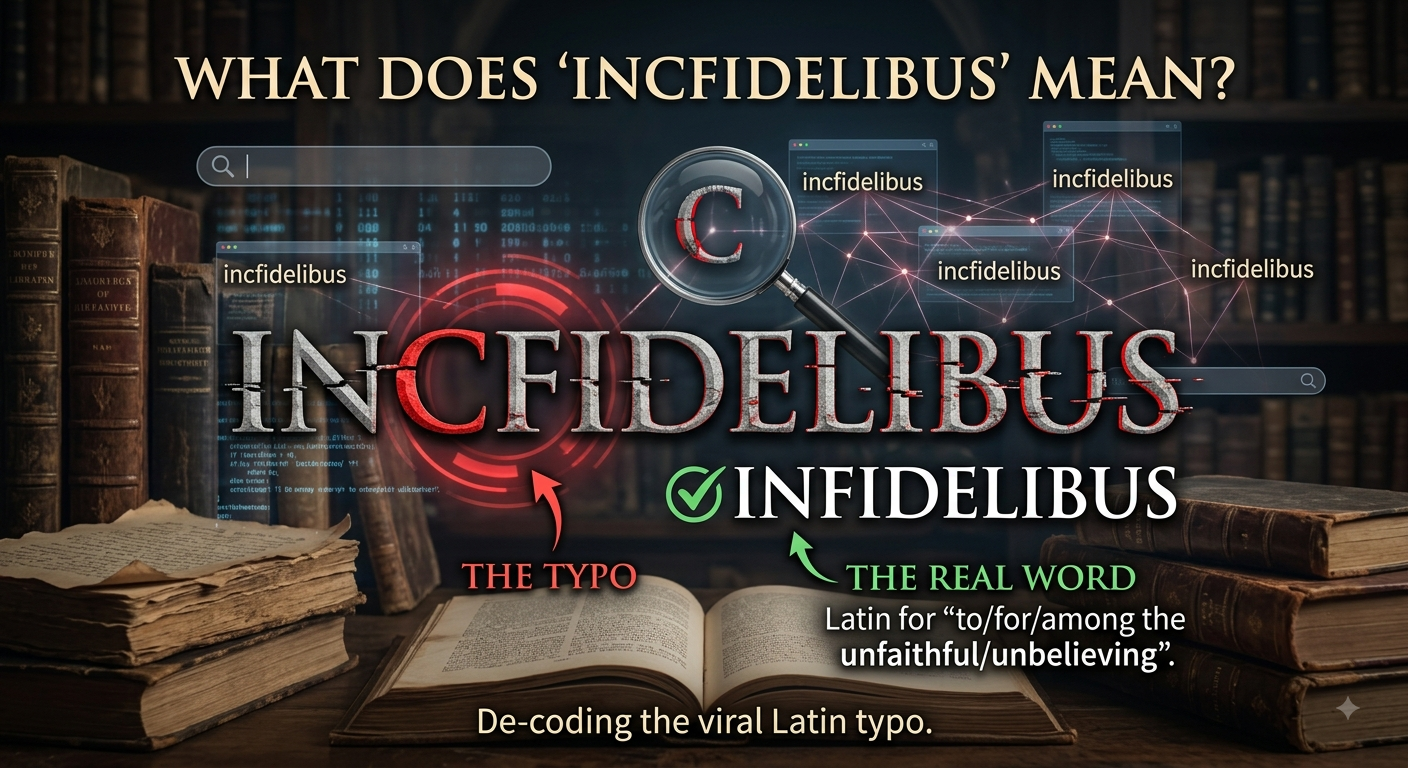
What Does “Incfidelibus” Mean? The Truth Behind the Viral Latin Typo
If you’ve stumbled across the word “incfidelibus”—maybe in a search bar rabbit hole, a strange email, or a friend’s confused text message—you’re not alone. Despite its ancient, almost mystical appearance, this word has a surprisingly mundane backstory. Here’s the real explanation, without the internet noise.
The Short Answer
“Incfidelibus” is not an actual Latin word. It’s a misspelling — nothing more, nothing less. The genuine word hiding underneath the typo is infidelibus, a grammatical form of the Latin adjective infidelis, meaning “unfaithful” or “unbelieving.” Somewhere along the way, an extra “c” slipped in between “in” and “fidelibus,” and that small error has been quietly multiplying across the internet ever since.
Breaking Down the Real Word: Infidelibus
To understand where “incfidelibus” came from, it helps to look at the word it’s imitating.
- Infidelis is the root adjective, built from the negative prefix in- (“not”) attached to fidelis (“faithful” or “loyal”). Together, they form a word meaning someone or something lacking faith or loyalty.
- “Infidelibus” is simply a declined form of that adjective—specifically the dative or ablative plural, an ending common throughout Latin grammar (think of it as roughly equivalent to “to/for the unfaithful” or “among the unfaithful” in English).
This isn’t obscure or invented. It’s a standard, functional piece of Latin grammar that would have appeared naturally in older texts touching on themes of faith, loyalty, and belief.
So Where Did the Extra “C” Come From?
There’s no deep etymology behind the “c” in “incfidelibus”—no hidden prefix, no forgotten dialect, no secret meaning. It appears to be a straightforward typographical error: someone typed the word incorrectly at some point, and instead of fading away like most typos do, this one caught on.
Once a misspelled term starts generating search traffic, a predictable cycle kicks in:
- Someone searches the misspelled version, either by accident or because they saw it somewhere unusual.
- Search engines register rising interest in the term, even though it’s technically incorrect.
- Content sites notice the spike and rush to publish articles “explaining” the word—often without solid research behind them.
- The cycle repeats, reinforcing the misspelling’s visibility rather than correcting it.
This pattern is common with obscure or foreign-language words that get slightly altered online. The typo essentially develops a life of its own, separate from the real word it came from.
Why Automated Content Made It Worse
A lot of what shows up when you search “incfidelibus” today isn’t rooted in genuine linguistic research. Much of it comes from automated or low-effort content written specifically to capture search traffic from curious users—without actually clarifying anything. This is why you might see wildly different, even contradictory, explanations for the same word: some framing it as a lost artifact, others as a brand name, others as a concept about trust or loyalty. None of these interpretations reflect an established or documented meaning. They’re reactions to search demand, not historical fact.
The Bottom Line
Language on the internet doesn’t always evolve through tradition or careful scholarship — sometimes it evolves through a single typo, a curious search, and a wave of content trying to keep up. “Incfidelibus” is a clear example of that process in action. Strip away the extra letter, and what’s left is a perfectly ordinary Latin word describing those who are unfaithful or without belief—nothing mysterious, just grammar with a typo attached.




Post Comment